
Mt Fuji Sunrise Times: Monthly Quick-Reference Table
At the summit (3,776 m), the horizon sits lower than it does from sea level, so the sun appears a few minutes earlier than at ground-level locations. The table below gives approximate sunrise times during the official climbing season (July–September). Always check the exact time for your travel date from a reliable astronomical source before you go.
| Period | Approximate Sunrise Time | Notes |
|---|---|---|
| Early July | approx. 4:20–4:30 | Earliest sunrise of the season; nights are bitterly cold |
| Mid–Late July | approx. 4:30–4:45 | Post-rainy-season; higher clear-sky rates |
| Early August | approx. 4:45–4:55 | Peak crowds; summit can be extremely congested |
| Mid–Late August | approx. 4:55–5:10 | Typhoon risk increases; always check forecasts |
| Early September | approx. 5:05–5:15 | Fewer climbers; temperatures noticeably colder |
| Mid-September onward | approx. 5:15–5:30 | Near season close; winter-level gear required |
* Times above are approximate. Verify the precise sunrise time for your date using an authoritative astronomical calculator. Cloud cover can obscure the sun for several minutes beyond the listed times.
What Is Goraiko? Cultural Significance and History
"Goraiko" (御来光) is the Japanese word for the sunrise seen from a mountain summit. Written with the characters meaning "the sacred light arrives," it conveys a sense of divine visitation rather than a simple meteorological event. On Mt Fuji — Japan's highest and most revered peak at 3,776 m — Goraiko carries layers of spiritual meaning that have accumulated over more than a thousand years.
Mt Fuji has been an object of religious veneration since at least the Heian period (794–1185 CE). Ascetic practitioners of Shugendo, a form of mountain worship that blends Buddhism and Shinto, climbed the volcano as a rite of purification. Reaching the summit before dawn and witnessing the sun rise from above the clouds was considered a direct encounter with the divine. By the Edo period (1603–1868), a popular religious movement called the Fujiko had spread across Japan, and millions of ordinary citizens dreamed of making the pilgrimage at least once in their lifetime specifically to see the Goraiko.
Today, secular climbers far outnumber religious pilgrims, but the experience retains its transformative quality. Spending hours in darkness, cold, and physical effort — and then watching the sky explode in shades of crimson, violet, and gold — produces an emotional intensity that is difficult to replicate anywhere else. Many first-time Fuji climbers describe the Goraiko as the single most powerful travel experience of their lives.
The Science Behind the Colors: Why Is the Sunrise So Red?
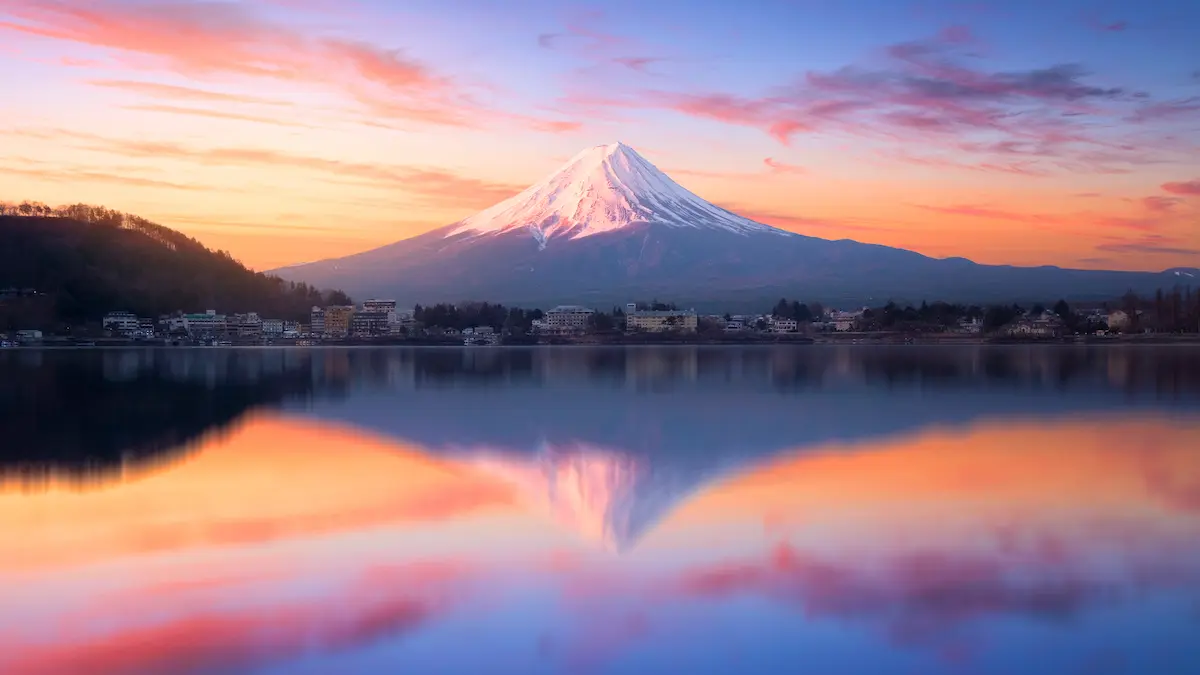
The vivid reds and oranges of a high-altitude sunrise are the result of Rayleigh scattering. When the sun is near the horizon, its light must travel through a much thicker slice of the atmosphere to reach your eyes. Short-wavelength blue and violet light scatters away before it arrives, leaving only the long-wavelength reds, oranges, and yellows to paint the sky. At 3,776 m, the atmosphere above you is significantly thinner than at sea level, which amplifies these warm tones and reduces the haze that often mutes the effect at lower elevations.
When a sea of clouds (雲海, unkai) lies below the summit, the effect becomes extraordinary. The clouds catch and reflect the first rays of sunlight in pinks and purples, while the sun itself rises as a searing sphere of orange above the cloud layer. The contrast between the silent, dark world below the clouds and the incandescent sky above is the image that draws climbers back to Fuji again and again.
Best Spots to See the Goraiko: A Complete Comparison
The summit is not the only place to experience the Mt Fuji sunrise. Depending on your fitness level, schedule, and budget, you can choose the option that suits you best — from a fully guided overnight ascent to a lakeside visit with no hiking required.
🏔 Summit (3,776 m)
Difficulty: High
The ultimate Goraiko experience. A 360-degree panorama above the clouds with the full spectacle of the sunrise. Requires a 12–16 hour round-trip hike.
- Most vivid and emotionally powerful sunrise
- Guided tours strongly recommended
- Summit temperature: 0–5°C even in summer
- Altitude sickness (AMS) risk is real above 3,000 m
⛰ 8th–9th Station (3,000–3,400 m)
Difficulty: Moderate–High
Even if you don't reach the summit, the sunrise from the upper mountain huts is genuinely breathtaking. You are often above the cloud layer, which creates a stunning visual contrast.
- Less physically demanding than the full summit push
- Classic plan: overnight at a mountain hut, depart before dawn
- Aim to reach the ridge 30 minutes before sunrise
- Wind-proof, warm layering is essential
🗺 5th Station (2,300 m)
Difficulty: Low
Accessible by bus or car without any hiking. Open year-round (road conditions permitting). When clouds sit below 2,300 m, you get an incredible sea of clouds at sunrise.
- Ideal for those not physically able to climb
- Take an early-morning bus or taxi from the base
- Yoshida 5th Station has restaurants and souvenir shops
- Weather-dependent — you may be inside the cloud layer
No-Hike Sunrise Spots Around Mt Fuji
| Location | Elevation | Access | Highlights |
|---|---|---|---|
| Lake Kawaguchi (Fujikawaguchiko) | approx. 820 m | ~2 hrs bus from Shinjuku | Reflected "upside-down Fuji" on the lake surface; Diamond Fuji in April and August |
| Lake Yamanaka (Panorama-dai) | approx. 1,100 m | ~2 hrs train + bus | Full view of Mt Fuji's profile; beautiful snow-capped contrast in winter |
| Lake Tanuki (Shizuoka) | approx. 650 m | Bus + walk from Shin-Fuji Stn | Famous Diamond Fuji site (around April 20 and August 20) |
| Lake Shoji (Fuji Five Lakes) | approx. 900 m | Bus from Kawaguchiko | The "Child-Embracing Fuji" silhouette; tranquil and rarely crowded |
| Ryugadake (near Lake Motosu) | approx. 1,485 m | ~1.5 hr hike from Lake Motosu | New Year's Day Diamond Fuji — sun rises directly from the summit at dawn on Jan 1 |
Planning Your Goraiko Hike: Schedule and Mountain Hut Strategy
The most popular and safest way to catch the summit sunrise is a one-night, two-day itinerary: climb to the 8th or 9th Station on the first afternoon, spend the night at a mountain hut, then resume the ascent in the early hours of the second morning. This plan gives your body time to acclimatize and dramatically reduces the risk of altitude sickness compared with a single-push overnight attempt.
Recommended Timeline (Yoshida Route, 8th Station hut overnight)
| Time | Activity | Key Points |
|---|---|---|
| Day 1, 1:00–3:00 PM | Arrive at the 5th Station (2,300 m); acclimatize | Spend at least 1 hour at the 5th Station before ascending |
| Day 1, 3:00–6:00 PM | Hike from 5th Station to 7th–8th Station | Keep a slow, steady pace — this is the single most important rule for AMS prevention |
| Day 1, 6:00–7:00 PM | Check in to 8th Station hut; dinner | Huts are dormitory-style; earplugs and an eye mask are very useful |
| Night, 1:00–2:00 AM | Wake up, layer up, and leave the hut | Headlamp is mandatory; your body will feel cold and stiff — warm up slowly |
| Night, 2:00–4:00 AM | Ascend from the 8th Station to the summit | Queues form quickly in peak season; leaving earlier gives you a buffer |
| Early morning, ~4:00–4:30 AM (July) | Watch the Goraiko from the summit | Find a sheltered spot from the wind; keep moving slightly to stay warm |
| Post-sunrise, to ~7:00 AM | Explore the summit crater rim (Ohachimeguri); begin descent | The crater walk takes about 1 hour; the highest point, Kengamine, is the spot for a certificate stamp |
| ~11:00 AM–12:00 PM | Descend back to the 5th Station | Most routes have a separate descending trail — stay on the correct path |
Booking Mountain Huts
During the official climbing season (July–September), huts book up extremely fast — often months in advance for popular August dates around the Obon holiday period (mid-August). If you are joining an organized tour, hut reservations are typically included. Independent climbers should book at least one to two months ahead. A one-night stay with dinner and breakfast costs roughly ¥10,000–¥15,000 per person. Huts are communal sleeping arrangements, similar to a ship's bunk room, so pack earplugs, an eye mask, and a thin sleeping bag liner for comfort.
Photographing the Goraiko: Camera Settings, Gear, and Composition
The Mt Fuji sunrise is one of the most sought-after photography subjects in Japan. But the conditions are genuinely challenging: rapidly changing light from near-darkness to brilliant glare, strong and gusty winds, trembling hands from the cold, and limited space to set up equipment. Preparation and the right settings make the difference between a mediocre snapshot and a portfolio image.
📷 Mirrorless / DSLR Recommended Settings
- Mode: Aperture Priority (Av) or full Manual (M)
- Aperture: f/8–f/11 (renders sky gradients cleanly)
- ISO: 800–3200 before sunrise; reduce to 400–800 after
- Shutter speed: 1/60–1/500 sec (adjust to the available light)
- White balance: Fixed Daylight (5500 K) — avoids shifting colours mid-burst
- Focus: Switch to manual focus, set to infinity, then fine-tune
- Format: Shoot RAW for maximum editing latitude
📱 Smartphone Photography Tips
- Use Pro/Manual mode if your phone supports it — take control of ISO and shutter speed
- Enable the grid overlay to keep the horizon level
- Use the volume button or a Bluetooth shutter remote instead of tapping the screen to prevent blur
- Keep the battery in a warm inner pocket — cold kills battery life fast
- HDR mode works well just after sunrise when bright sky meets dark foreground
- Edit in Lightroom Mobile or the native editor to recover shadow detail in RAW or HEIC files
Essential Photography Gear to Pack
- Lightweight travel tripod: Indispensable for long exposures in pre-dawn darkness. Weight is a real concern on a mountain hike, so choose carbon fibre or a compact aluminium model.
- Wireless remote shutter release: Eliminates camera shake entirely. A Bluetooth model removes the need for a cable connection.
- Wide-angle lens (16–24 mm): Perfect for sweeping sea-of-clouds compositions with the sunrise above.
- Telephoto lens (70–200 mm): Compresses distance dramatically to show the lakes or towns far below in relation to the glowing sky.
- ND filter: Balances the exposure between the bright sky and the darker foreground after sunrise.
- Multiple spare batteries: Cold temperatures drain batteries 2–3× faster than normal. This is the single most important item many photographers forget.
- Zip-lock bags: The cheapest and most effective way to protect camera gear from condensation, mist, and sudden rain.
Sunrise from the 5th Station: The No-Climb Alternative
For those who want to witness the Mt Fuji sunrise without the physical and logistical demands of a full overnight climb, the 5th Station at approximately 2,300 m is a compelling option. At this elevation, there is a genuine chance — particularly on high-pressure mornings — of sitting above the cloud layer and watching the sun rise over a glowing sea of clouds.
Getting to the 5th Station Before Sunrise
The Yoshida 5th Station (Fuji Subaru Line 5th Station) is served by shuttle buses from Fujisan Station during the climbing season. Taking an early-morning service will get you there in time for sunrise. Taxis are also available but carry a late-night surcharge for journeys outside normal hours. Note that the Fuji Subaru Line has nighttime closure periods outside the climbing season (October–June), so always check road status in advance before planning a non-summer sunrise visit.
Things to Keep in Mind at the 5th Station
- If clouds are sitting above 2,300 m, you will be inside the cloud and will see nothing — this is a real possibility, especially before the rainy season ends in mid-July
- The 5th Station temperature in the pre-dawn hours is typically 5–10°C even in August; a warm layer is non-negotiable
- After sunrise, tourist traffic increases rapidly; leaving early is advisable to avoid bus queues on the way back
- Restaurants and shops at the 5th Station do not open until mid-morning; bring your own food and drinks if arriving before sunrise
The 5th Station sunrise has a distinct magic that even summit veterans appreciate. The extended "magic hour" — watching the sky transition slowly from deep navy to violet to rose to orange over 30–40 minutes — is something you simply cannot savour at the summit, where cold and fatigue tend to dominate. At the 5th Station, you can sit comfortably, sip hot coffee from your thermos, and absorb every shade of the colour show without any time pressure. It is a genuinely beautiful experience in its own right.
— Editorial team, 10+ Fuji climbsGoraiko Without Climbing: Lakes, Viewpoints, and Diamond Fuji
Families, visitors with physical limitations, or anyone whose schedule does not allow for an overnight hike can still experience a Mt Fuji sunrise that rivals the summit in its own way. The spots below are all accessible without climbing and offer unique photographic and scenic perspectives.
What Is Diamond Fuji?
"Diamond Fuji" (ダイヤモンド富士) is a rare and spectacular optical phenomenon that occurs when the rising or setting sun aligns precisely with the apex of Mt Fuji's summit cone, creating a brilliant jewel-like flare at the mountain's peak. Because the alignment depends on the angle between the observer's position and the sun's path, each viewing location only experiences Diamond Fuji on a small number of days each year.
Key Diamond Fuji locations and dates:
- Lake Tanuki (Shizuoka): Around April 20 and August 20 at sunrise
- Lake Yamanaka / Panorama-dai: Mid-October to early November at sunset
- Lake Motosu (Ryugadake): Around January 1 — the New Year's Diamond Fuji sunrise
- Takasashiyama (around Lake Yamanaka): Late October to November at sunset
Lake Kawaguchi Sunrise Viewing Guide
Lake Kawaguchi is the most accessible of the Fuji Five Lakes, just two hours by bus from Shinjuku. The lake's northern shore — particularly around the town hall area and Oishi Park — offers a direct south-facing view of Mt Fuji with the lake surface providing the famous "inverted Fuji" (Sakasa Fuji) reflection when the water is calm. The best conditions are on windless mornings in autumn and winter (October–February), when Mt Fuji is capped with snow and the air is crystal clear.
During autumn and winter, the sun rises to the northeast of Mt Fuji, meaning sunrise light illuminates the right flank of the mountain. This creates warm, raking shadows across the snow cone that are especially beautiful in photography.
What to Wear for the Goraiko: Altitude-by-Altitude Clothing Guide
Watching the sunrise on or near Mt Fuji means spending an extended period outdoors before dawn, often in wind and cold well below what summer temperatures at the base would suggest. A layering system — multiple thin, removable layers rather than one heavy garment — is the key strategy.
🏔 Summit and 8th Station and Above (July–September)
- Base layer: Moisture-wicking long-sleeve top (polyester or merino wool)
- Mid layer: Fleece jacket or lightweight down insulator
- Outer shell: Hardshell windproof and waterproof jacket — non-negotiable
- Legs: Hiking trousers plus rain trousers over the top
- Hands: Thin liner gloves inside waterproof outer gloves
- Head: Warm beanie covering the ears
- Neck: Neck gaiter or balaclava for wind protection
Average summit temperature: July approx. 3°C, August approx. 6°C, September approx. 2°C. Wind speeds above 10 m/s (common at the summit) make it feel significantly colder.
🗺 5th Station and Lakeside Viewpoints
- T-shirt + thin hoodie or shirt: Still needed even in summer
- Lightweight down jacket: Essential while waiting for the sun to rise
- Windbreaker: The 5th Station is almost always windy
- Long trousers: Pre-dawn temperature is typically 5–12°C
- Trainers or light hiking shoes: Fine for the 5th Station walkway and lakeshores
- Thin gloves: Keeps fingers functional for operating camera controls
Pack Weight Considerations
Every extra kilogram in your pack is felt acutely above 3,000 m, where the thin air means your cardiovascular system is already working harder than normal. Keep total pack weight to 10–12 kg maximum for an overnight hike. Ruthlessly cut duplicate items and consider renting gear (boots, rain jacket, trekking poles) on-site at the 5th Station if you do not already own suitable equipment. Rental services at the Yoshida 5th Station are well-stocked and competitively priced.
A First-Time Goraiko: Personal Account from Our Team
My first Goraiko hike was in the second week of August. I left the 8th Station hut at 1:30 AM. Outside, the mountain was completely dark. The only light came from a chain of headlamps stretching both above and below me along the path — hundreds of tiny moving lights that looked, from a distance, like a long string of fireflies tracing the contours of the mountain. Even before the sunrise, that image alone felt worth the trip.
By the 9th Station the wind had picked up dramatically, and the cold was fierce — I estimate the wind chill was well below -5°C. My double-gloved hands were clumsy on my camera controls. I arrived at the summit about forty minutes before sunrise, found a sheltered alcove near the Sengen Shrine, and waited.
The transformation of the sky was gradual and then suddenly overwhelming. Deep indigo shifted to violet, violet to rose, rose to a burning orange-gold stripe along the eastern horizon. The sea of clouds below was perfectly flat, silent, and seemed to extend forever. When the first sliver of sun broke the horizon, someone behind me started crying. Strangers who had exchanged no more than nods on the trail found themselves shaking hands and exchanging clumsy congratulations in different languages.
I had told myself that the 5th Station would probably be sufficient for a sunrise experience. I was wrong. The summit Goraiko is categorically different — not in the colours of the light, but in the intensity of the feeling that comes from earning it.
— Editorial team, 3 summit Goraiko experiencesFrequently Asked Questions About the Mt Fuji Goraiko Sunrise
During the official climbing season (July–September), the approximate summit sunrise times are: 4:25–4:45 AM in July, 4:45–5:10 AM in August, and 5:05–5:25 AM in September. These times shift daily, so use an astronomical sunrise calculator to find the exact time for your specific date. Cloud cover can delay your first glimpse of the sun by several minutes.
Departing from an 8th Station hut (around 3,100 m) roughly 2–2.5 hours before sunrise is the standard recommendation. During the peak season (late July to mid-August), the trail above the 8th Station can be extremely crowded, slowing progress significantly. Aiming to leave around 1:00–2:00 AM gives you a comfortable buffer. Your goal is to reach the summit 30–45 minutes before sunrise.
Absolutely. The lakeshores of Kawaguchiko, Yamanakako, and Lake Tanuki, as well as the 5th Station, all offer impressive sunrise views. The Diamond Fuji phenomenon — where the rising sun aligns precisely with the mountain's summit — is visible from specific lakeside locations on just a handful of days per year and requires no hiking whatsoever. See our section above for specific locations and dates.
The five non-negotiables are: (1) a reliable headlamp with spare batteries, (2) warm insulating layers — a fleece or down jacket plus a hardshell wind and rain jacket, (3) waterproof gloves, (4) high-cut hiking boots with ankle support, and (5) waterproof rain trousers. Summit temperatures from July to September range from 0–6°C, and wind chill can push the apparent temperature well below freezing. Underdressing for the Goraiko hike is one of the top causes of emergency situations on the mountain.
For mirrorless or DSLR cameras: ISO 800–3200, aperture f/8–f/11, shutter speed 1/60–1/250 sec as a starting point. Use a tripod and a remote shutter release, fix white balance to Daylight (5500 K), and shoot in RAW format. For smartphones, activate Pro/Manual mode, use the volume button to trigger the shutter to avoid camera shake, and keep the phone warm in an inner pocket between shots.
Look for these four things: (1) mountain hut accommodation is included in the package, (2) an English-speaking guide is available if you need one, (3) equipment rental is offered as an add-on, and (4) the cancellation policy for bad weather is clearly stated. For first-time climbers, a fully guided 1-night, 2-day package is the safest and most stress-free option. Read user reviews on booking platforms such as Klook to get a realistic picture of other travellers' experiences.
The estimated clear-sunrise success rate across the entire season is roughly 50–60%. August tends to have more afternoon thunderstorms and cloud build-up, while the period just after the rainy season ends in late July often offers the best conditions. Even if you find yourself above a sea of clouds rather than looking at a clear horizon, watching those clouds turn pink and gold is an unforgettable spectacle in itself. Always check a mountain-specific weather forecast (such as the Tenki.jp mountain forecast) the afternoon before your planned ascent.
Experience the Sacred Goraiko on Mt Fuji
A sunrise above the clouds from Japan's highest peak is the kind of moment you carry with you for the rest of your life. Let a guided tour take care of the logistics so you can focus entirely on the experience.
Book Your Goraiko Tour Now ➔Early booking discounts available. Many tours offer free cancellation.